// Mega Mission
MegaETH democratizes what no other chain has: guaranteed low-latency access to a real-time blockchain. Traders will pay for proximity to the sequencer. Applications denominate and grow in USDm.
Rewards that the Foundation receives from USDm are used to buy back MEGA. The more the ecosystem grows, the more MEGA gets absorbed by the MegaETH Foundation.
USDm, issued through Ethena's stablecoin stack, is MegaETH's native stablecoin purpose built to power real-time applications on MegaETH.
Most L2s monetize by charging an extra margin on sequencer fees. With USDm, MegaETH redirects value from financial yield rather than users to fund the network.
Read morePoints are earned through activity across participating apps in the MegaETH ecosystem. More activity drives more USDm onchain, fueling the flywheel that powers the whole network.
Track points and discover qualified apps on Terminal, the main hub for the points program.
Explore nowTraders need low latency. MegaETH sells it. Proximity Markets utilize MegaETH's core advantage, guaranteed low latency, by taxing proximity to the sequencer, rather than extracting value through gas fees or sequencer surcharges.
Proximity Seat: Reserved server slots near the sequencer, tiered by latency. Top-tier seats are auctioned; mid-tier combines auction + MEGA locking; entry-level requires locking only.
Proximity Feed: Real-time data streams synchronized to a shared global clock. It is designed to complement Proximity Seat by eliminating software-layer bottlenecks.
Tiered access: auction, staking, or both
Fairness via in-tier jitter randomization
HFT-grade data feeds aligned to canonical transaction ordering
All rewards that the MegaETH Foundation receives from USDm are used to buy back and accumulate MEGA.
As USDM adoption grows across applications in the ecosystem, buybacks scale with it.
Buybacks are executed regularly consistent with applicable law and regulation.
USDm rewards → MEGA buybacks
Scales with ecosystem adoption
MegaETH rotates sequencer operation across regions to keep latency close to where users are active. Operators stake MEGA to participate.
Selection is based on stake and performance, delegation is supported, and faults are slashed.
Rotation follows global demand
Performance + stake decide who runs
Delegation + slashing enforce reliability
// Mega Rewards
When each KPI tranche is reached, a pre-defined amount of MEGA is released to holders with committed positions. The longer you commit, the larger you share.
Commit Now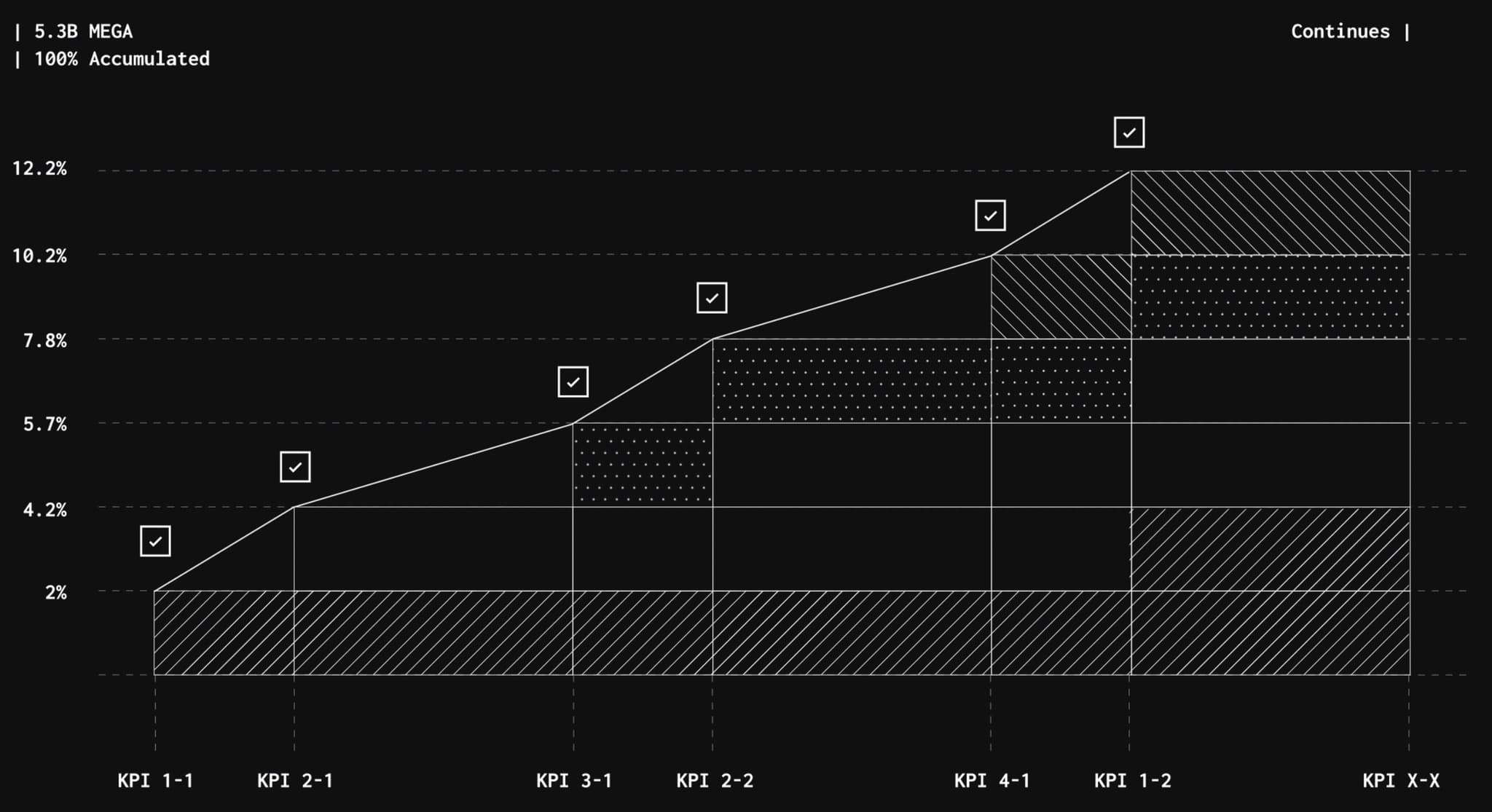
KPI Rewards tie token emissions to outcomes, not dates.
MEGA tokens are emitted to users with commit positions based on objective network milestones — not a fixed schedule. When KPIs are achieved and attested, holders who have committed MEGA become eligible for rewards.
Over half of total supply is reserved for KPI-based distribution. Participants are the beneficiary as the network proves real usage over time.
Eligibility is based on continuous MEGA committment before a KPI attestation.
Maturity is how much of your commitment counts toward reward distributions. The longer you stay committed, the higher your maturity up to 100% maturity — and the greater your share of any rewards that get distributed.
Maturity builds linearly, every second, from 0% when you first commit up to 100% at full maturity.
KPIs are measurable milestones across four verticals: reliability, performance, adoption, and decentralization.
The full KPI set is published on this site and includes: uptime, block times, finality, gas used, transaction count, revenue, USDM adoption, Ethereum alignment, validator safety, and concentration/fairness metrics.
Governance roadmap:
Phase 1 (now): The Foundation defines KPIs and performs attestations.
Phase 2: Governance takes over KPI definition for later tranches. Token holders vote on what milestones matter, shifting control to the community as the network matures.
Phase 3 (future): Oracle-based KPI verification replaces manual attestation entirely, removing human judgment from the loop.
When KPI targets are hit and rewards are distributed, holders can claim and re-commit newly received tokens.
KPI Rewards tie token emissions to outcomes, not dates.

Eligibility is based on continuous MEGA committment before a KPI attestation.

KPIs are measurable milestones across four verticals: reliability, performance, adoption, and decentralization.

When KPI targets are hit and rewards are distributed, holders can claim and re-commit newly received tokens.

// MEGA Economics
*Includes Echo, Fluffle,
SONAR, Mainnet Campaign
**Unsold or undelivered tokens due to KYC, sybil, or other reasons are
transferred to Foundation and will be used for the growth of the network
***Differences may be
due to rounding, or a result of sybil and KYC issues
If you invested in the Echo private sale, you will receive an email prompting you to log in to the Echo platform to claim your available MEGA tokens
You'll claim all future vests on Echo. 20% unlocks on April 30th, 2026.
If you hold a Fluffle NFT:
50% of your tokens are automatically delivered to your wallet (exceptions apply) on April 30th, 2026.
The rest vest over 6 months.
If you were granted a public sale allocation:
Your tokens are automatically delivered to your bidding wallet on April 30th, 2026 or April 30th, 2027 if lockup applies.
// MEGA Journey
MegaETH started as a whitepaper proposing a non-traditional approach to scaling Ethereum: specialize node roles instead of forcing every node to do everything, pushing EVM performance to new, real-time limits.
The thesis attracted early, long-term supporters: Ethereum co-founders Vitalik Buterin and Joseph Lubin, funds like Dragonfly and Figment, alongside community leaders like Cobie and performance-minded operators like Mert Mumtaz.
Later that year, we opened MegaETH to everyday participants on Cobie's Echo, on the same terms as the seed round (equity + token warrants, same nine-figure valuation).
It was Echo's largest sale to date, raising $10M.
In the run-up to mainnet and the MEGA TGE, we opened ownership to the public through Sonar (by Echo): a 72-hour English auction selling 5% of total supply, with a $1M FDV floor and $999M FDV ceiling. The sale drew 50K+ bidders and $1.39B committed.
When MegaETH's public testnet went live, "real-time" stopped being a claim and became something builders could feel: 10ms miniblocks and ~1.7 Gigagas/s of single-threaded throughput.
Teams started deploying latency-sensitive apps and learning what it actually looks like to build at ultra-low latency. Builders coalesced around MegaETH, with the Mega Mafia raising over $70M in venture financing.
Mainnet is the starting line. MegaETH launches with USDm as the lifeblood of the ecosystem, creating a flywheel between applications and the chain: as apps grow, USDm adoption deepens; as USDm scales, protocol economics strengthen; and stronger economics fund further growth across builders, liquidity, and distribution.
This is the shift from crypto as a speculative sandbox to crypto as a sustainable, high-performance economic system, where real usage compounds and real-time execution opens an entirely new design space.
MegaETH proved the real-time thesis in production in a stress test: 11 billion transactions in 7 days, which is the largest transaction count in EVM history, while the network remained usable for latency-sensitive apps and onchain games.
What started as a whitepaper claim became an engineering fact. Real-time execution isn't theoretical anymore. It's a live production environment with applications already running on it.
Upon mainnet launch, MegaETH established an industry-first KPI-triggered TGE schedule: the token would go live only when the network earned it, which is when hitting any one of four designated performance milestones.
On April 23rd, 2026, the KPI of having a total of 10 MegaMafia apps deployed on the chain was hit, triggering the MEGA TGE on April 30th, 2026.
10/10 MegaMafia Apps · KPI Accomplished










MegaETH started as a whitepaper proposing a non-traditional approach to scaling Ethereum: specialize node roles instead of forcing every node to do everything, pushing EVM performance to new, real-time limits.
The thesis attracted early, long-term supporters: Ethereum co-founders Vitalik Buterin and Joseph Lubin, funds like Dragonfly and Figment, alongside community leaders like Cobie and performance-minded operators like Mert Mumtaz.
Later that year, we opened MegaETH to everyday participants on Cobie's Echo, on the same terms as the seed round (equity + token warrants, same nine-figure valuation).
It was Echo's largest sale to date, raising $10M.
In the run-up to mainnet and the MEGA TGE, we opened ownership to the public through Sonar (by Echo): a 72-hour English auction selling 5% of total supply, with a $1M FDV floor and $999M FDV ceiling. The sale drew 50K+ bidders and $1.39B committed.
When MegaETH's public testnet went live, "real-time" stopped being a claim and became something builders could feel: 10ms miniblocks and ~1.7 Gigagas/s of single-threaded throughput.
Teams started deploying latency-sensitive apps and learning what it actually looks like to build at ultra-low latency. Builders coalesced around MegaETH, with the Mega Mafia raising over $70M in venture financing.
Mainnet is the starting line. MegaETH launches with USDm as the lifeblood of the ecosystem, creating a flywheel between applications and the chain: as apps grow, USDm adoption deepens; as USDm scales, protocol economics strengthen; and stronger economics fund further growth across builders, liquidity, and distribution.
This is the shift from crypto as a speculative sandbox to crypto as a sustainable, high-performance economic system, where real usage compounds and real-time execution opens an entirely new design space.
MegaETH proved the real-time thesis in production in a stress test: 11 billion transactions in 7 days, which is the largest transaction count in EVM history, while the network remained usable for latency-sensitive apps and onchain games.
What started as a whitepaper claim became an engineering fact. Real-time execution isn't theoretical anymore. It's a live production environment with applications already running on it.
Upon mainnet launch, MegaETH established an industry-first KPI-triggered TGE schedule: the token would go live only when the network earned it, which is when hitting any one of four designated performance milestones.
On April 23rd, 2026, the KPI of having a total of 10 MegaMafia apps deployed on the chain was hit, triggering the MEGA TGE on April 30th, 2026.
10/10 MegaMafia Apps · KPI Accomplished

